High-voltage battery testing: this is how you measure the SOH of an HV pack
A high-voltage battery carries hundreds of volts and costs thousands of euros. Yet, its condition can be determined in three minutes without disconnecting a single cable.

What is a high-voltage battery?
An electric car has two batteries. The familiar 12-volt battery powers the lights, the multimedia system, and the starting procedure. In addition, the traction pack lies under the floor: the high-voltage battery, usually somewhere between 350 and 800 volts. That pack supplies the energy the car runs on and is by far the most expensive part of the vehicle.
Such an HV pack consists of hundreds of individual cells, grouped into modules. The Battery Management System continuously monitors their voltage, temperature and the number of charge cycles. That system is also the source of the data we read. View which models we support.
What the SOH percentage of an HV battery does and does not say
The State of Health is the ratio between the capacity the battery pack can still store today and the capacity it had when it left the factory. At 100%, the pack is as good as new. At 85%, 15% of the original capacity has been lost.
Just as important is what that number doesn't tell you. It doesn't predict how the car will behave tomorrow in freezing temperatures, and it tells you nothing about the previous owner's driving style. Measuring battery SOH gives the current state of affairs of the pack, not a prediction. That is precisely why it is useful in a transaction: it is a fact instead of an estimate.
Telematics company Geotab analyzed the data of thousands of electric vehicles in 2023 and found an average loss of about 1.8% capacity per year. However, that average says little about a specific car: charging behavior, climate, and model vary too widely. Read the full explanation of the SOH test.
Measuring battery state of health in practice
There are two ways. The dynamic method drains the battery from full to almost empty and calculates the capacity from that. That method works, but takes hours to days and the car is occupied the entire time.
The static method reads the data directly from the Battery Management System via the OBD port. No test drive, no lift, no waiting time. Furthermore, when measuring the battery's state of health via the BMS, the result is independent of how full the battery is at that moment. The result is available within three minutes.
High-voltage battery testing without opening the hood
This is the point where many people stumble: for us, high-voltage battery testing does not mean that someone touches the high-voltage system. The measurement is carried out via the diagnostic port present in every vehicle. No hood is opened, no orange cable is disconnected, and no one with an HV certification is needed to perform the test.
That is not only practical, it is also safer. Working on a live HV system is a job for specially trained technicians. Reading data does not fall under that: we only read along and do not write anything. Factory warranties are not affected and no fault codes are cleared.
HV battery diagnosis: exactly what we read out
An EV battery diagnosis looks beyond the overall score. These four factors together determine the final verdict.
Remaining capacity
How many kilowatt-hours the pack can still store, compared to the factory value. This yields the SOH percentage.
Cell balance
The voltage differences between the individual cells, accurate to within millivolts. A pack that is out of balance is a different story than a pack that remains nicely aligned.
Charging history
The number of charge cycles and how often it was charged on a DC fast charger. Fast charging accelerates aging.
Final verdict
All values summarized according to the traffic light principle, linked to the chassis number of that specific car.
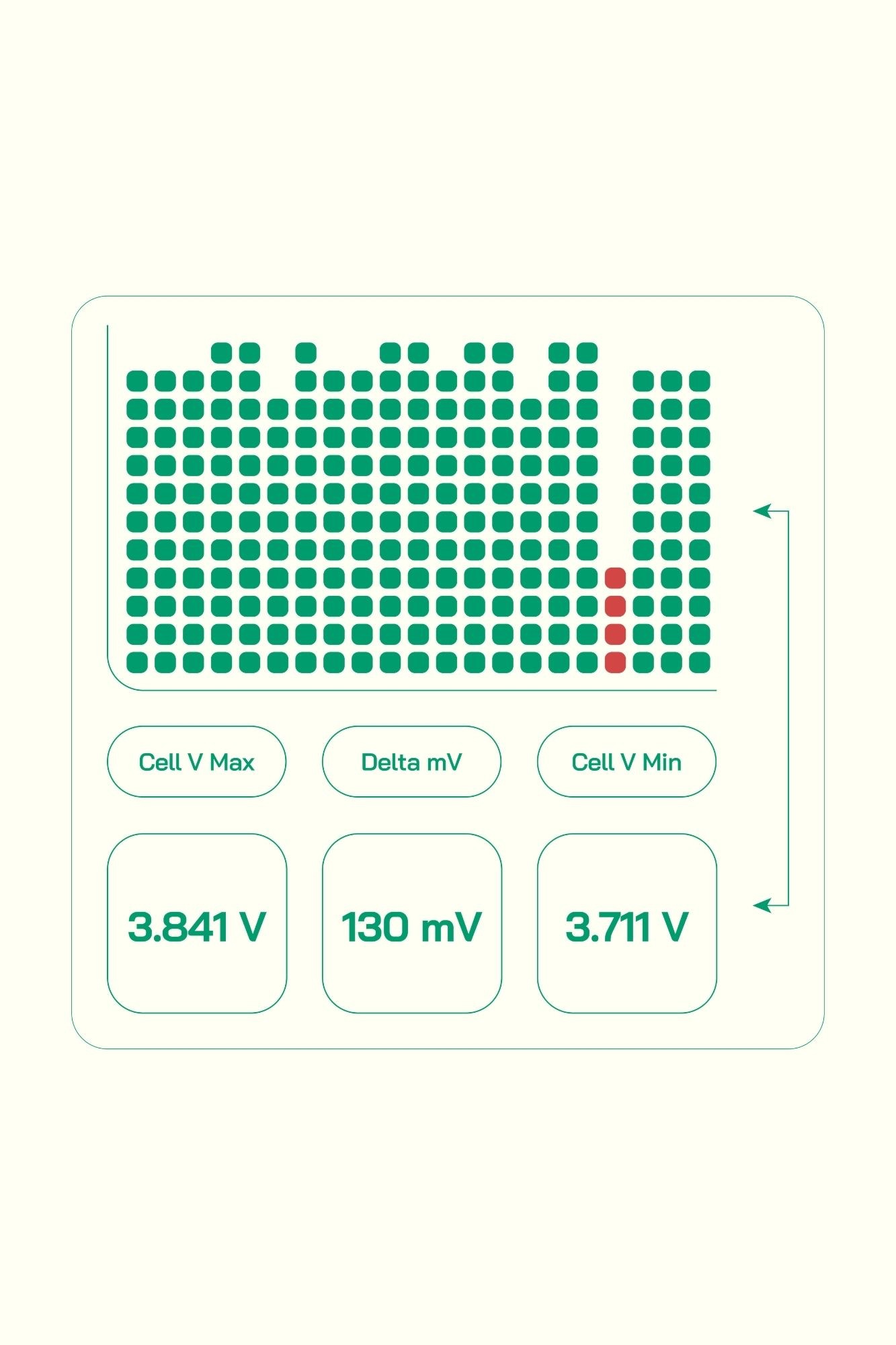
A pack with a neat overall score but cells that are millivolts apart deserves a different advice than a pack that remains balanced. You can only see that difference if you look at the cell level. This is what the battery report looks like.
What a low SOH means for the value
In practice, a replacement HV battery pack quickly costs between €7,000 and €15,000. For a car worth ten grand, that is the difference between a good buy and a bad deal. Therefore, the SOH of a second-hand EV is not a technical detail, but the most important indicator of its residual value.
By the way, it works both ways. A package that is in good shape is a selling point that you can present in black and white.
Frequently asked questions about high-voltage batteries
How do I measure the health of an EV battery?
Via the OBD port, our equipment reads the Battery Management System. Within three minutes, you will have the State of Health, the cell balance, and a final verdict.
Can I read the SOH of my car myself?
With the right equipment, yes. However, cheap universal dongles cannot bypass the manufacturer's security and will at most show a rough estimate.
What causes an EV battery to degrade?
Mainly due to charging behavior, temperature, and the number of cycles. Structurally fast charging up to 100% in full sunlight demonstrably costs more capacity than quietly charging up to 80%.
Can the test equipment damage anything?
No. We only read data and do not write anything. No settings are changed and no error codes are cleared.
Is your question not listed? View all frequently asked questions in the knowledge base.
Testing high-voltage batteries yourself
Car companies perform the measurement themselves using the TBE Toolkit. A one-time purchase of the case, and then € 29.95 excl. VAT per completed battery certificate. No subscription, no minimum purchase.