Battery certainty: checking the battery of an electric car
With a used EV, it is all about one component that you cannot see, cannot hear, and cannot test drive. Yet, its condition can be determined in three minutes.
Electric car battery status: why this is the key question
With a fuel-powered car, a buyer listens to the engine, looks at the maintenance booklet, and takes a test drive. With an electric car, that routine disappears. The most expensive component is located under the floor, makes no sound, and only reveals itself when it is too late.
As a result, the entire conversation shifts to a single question: what is the current status of the electric car battery. Everything that depends on it — the range, the residual value, the risk of an expensive replacement — comes back to that one piece of data.
Those who don't know are guessing. And with a package that costs between seven and fifteen thousand euros when new, guessing is an expensive habit.
Checking a battery electric car: what does and doesn't work
Four ways people try it, and what each method actually tells you.
The range on the dashboard
This is an estimate based on your recent trips and fluctuates with the weather. In January, every battery seems worn out. It says nothing about the actual capacity.
Take a test drive
At most, you might feel whether the car is delivering power. You will only notice wear and tear in the battery pack when you drive from full to almost empty, and nobody does that during a viewing.
A universal OBD scanner
Reads error codes and some general values. The protected manufacturer data, which contains the capacity, does not get through.
Reading the BMS
The control system keeps track of what happens in each cell. Anyone who accesses it with the correct key reads the actual condition instead of an estimate.
Checking an electric car battery in practice
With us, this happens in the parking lot or in the showroom, with the car stationary. The dongle goes into the diagnostic port, the app recognizes the vehicle and retrieves what the Battery Management System has stored. Nothing needs to be disassembled and nothing in the car is modified.
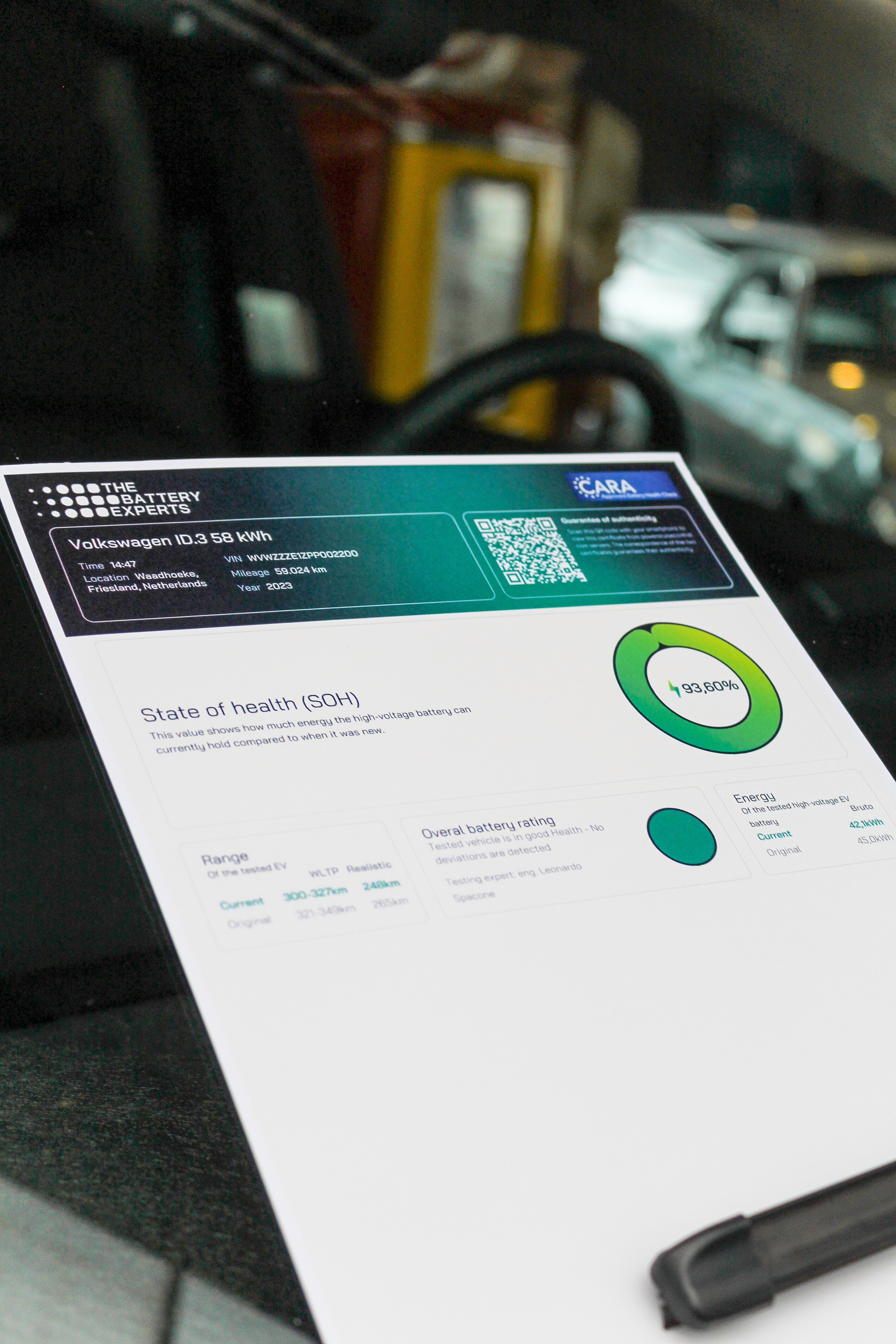
Within three minutes, the result is in. Not just a percentage, but also the picture behind it: how many kilowatt-hours can still go in, how the cells compare to each other, and how often it was fast-charged. That combination makes the difference between a number and a judgment.
Car battery condition: what to look out for in the report
Four things together determine whether a package is in good shape.
Remaining capacity
How much it can still hold compared to factory-new. This yields the percentage that everyone looks at.
Cell balance
If the cell values diverge significantly, that is a warning. A pack with a decent overall score but imbalanced cells deserves different advice.
Charging history
The number of cycles and the share of fast charges indicates how hard the car has been driven, regardless of the mileage.
Final verdict
All values summarized according to the traffic light principle, linked to the chassis number of this single vehicle.
When do you have the condition assessed?
The most obvious moment is right before a purchase. You then know what you are buying and you have something to discuss if the package is disappointing. Sellers turn it around: with a report in hand, they no longer have to explain that the battery is good, it is simply stated there.
Additionally, there are times when it is simply wise. Just before the manufacturer's warranty on the battery pack expires, for example, or when returning a leased car, where discussion about the state of the battery can become a costly issue. It also helps with trade-ins: you buy based on measured values instead of estimates.
Frequently asked questions about battery security
Can I check the battery of a second-hand EV myself?
With the right equipment, yes. Cheap universal dongles cannot bypass the manufacturer's security and will only give a rough estimate at best.
How do I recognize a weak battery?
On the remaining capacity and especially on the cell balance. Cells that diverge significantly point to a problem, even with an acceptable overall score.
Can the equipment damage my car?
No. The connection is one-way: data goes out, nothing comes in. Therefore, your manufacturer's warranty remains fully valid.
Where can I have my car tested?
At our location in Blaricum or at one of the affiliated partners. On the location page, you can see which place is closest to you.
Want to know more? View all frequently asked questions in the knowledge base.
Certainty about your battery, within three minutes
Make an appointment at our location or with a partner nearby. You will drive away with a CARA Approved report.