Battery degradation: what the SOH value means and what a test costs
In three minutes you will know how much capacity this battery has left
SOH meaning: what the percentage actually expresses
SOH stands for State of Health. It is a single number that indicates how much energy the battery pack can still store today, expressed as a percentage of the capacity with which it left the factory. If it says 92%, then eight percent of the original capacity has disappeared.
The SOH battery meaning is often confused with the state of charge. Those are two different things: the state of charge indicates how full the battery is right now, while the SOH indicates how large that battery still is. A full battery with an SOH of 80% simply won't go as far as that same battery on the day of delivery.
What the number does not do, is provide a prediction. It describes the condition at the moment of measurement. It is precisely this sobriety that makes it useful during a purchase or a trade-in: you negotiate over a fact instead of a suspicion.
What causes a battery pack to degrade in quality
Degradation does not have a single cause but a handful, and they interact with each other.
Charge cycles
Every charge and discharge cycle costs a small amount of capacity. It is not the number of kilometers that counts, but how often the battery pack has cycled.
Fast charging
A DC charger delivers a lot of power in a short amount of time. This generates heat, and heat measurably accelerates chemical aging.
Temperature
Both heat and frost stress the cells. A car parked in full sun during the summer while charging ages faster than a car in a garage.
Charging habit
Structurally charging to one hundred percent and driving until almost empty strains the extremes of the range. Staying between twenty and eighty percent makes a demonstrable difference.
Age
Even a stationary car slowly loses capacity. Chemistry simply ages, even without anyone driving it.
Model and chemistry
One pack is better cooled and better balanced than the other. Differences between brands and model years are larger than many people think.
What the process looks like in practice
Degradation does not progress in a neat, linear fashion. The first few percentages are lost relatively quickly in the first one to two years, after which the loss levels off and remains fairly flat for years. A pack that is at 93% in its third year is usually in a much better position than the first year would suggest.
Averages say very little about one specific car. Two identical models from the same year of manufacture can differ by percentage points, purely because of where they were driven and how they were charged. This is exactly why we measure per vehicle and not per model.
Testing SOH value: how it works
Testing the SOH value can be done in two ways. One involves letting the car run completely empty and calculating how much energy came out; that works, but it takes a day and the car is unusable during that time. The other reads the data directly from the Battery Management System, the control system that monitors each individual cell.
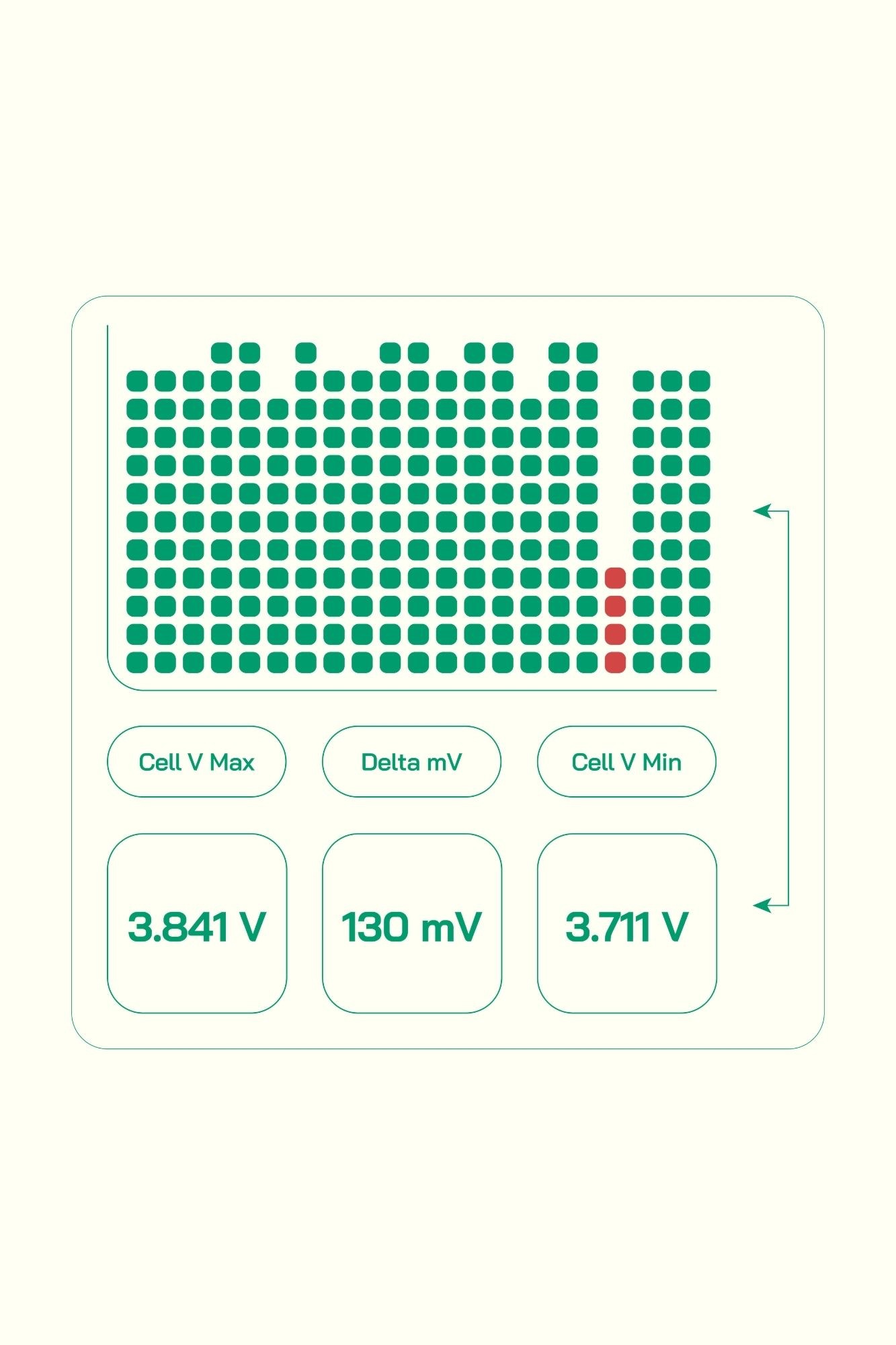
We do the latter. Via the diagnostic port, we retrieve what the BMS has recorded: the remaining capacity, the voltage per cell, the number of cycles, and how often it was fast-charged. We compare that raw data with our own database, which results in a single percentage plus a health assessment of the car battery in question.
Battery degradation test costs: what do you pay for it
For private individuals, a full measurement including an official report costs €80, including VAT. This includes everything: the test itself, the analysis at cell level, and the certificate in your mailbox. There are no additional costs afterwards.
Car companies that measure more frequently purchase the TBE Toolkit as a one-off for € 59.- excluding VAT, and then pay € 29.95.- excluding VAT per issued certificate. No subscription and no minimum purchase, so that costs align with what you actually use.
Put that amount next to what is at stake. In practice, a replacement battery pack can cost up to fifteen grand, and for a used car costing a few tens of thousands of euros, the condition of that pack determines a significant part of the value.
The electric car battery certificate
We record the outcome of the measurement in an electric car battery certificate: a report linked to the chassis number and therefore associated with that specific car. It states the remaining capacity, how the cells are balanced among themselves, and the corresponding final assessment.
Our method is CARA Approved, the European standard for battery diagnostics. That difference matters when it really counts: a printout from a universal scanner is just an opinion, while a certified report is a document that a buyer or leasing company can rely on.
The same actually applies to a plug-in hybrid. We measure the (PH)EV battery condition using the same equipment and the same method, only the battery pack is a lot smaller.
Frequently asked questions about battery degradation
What exactly does the SOH value mean?
It is the ratio between the capacity that the pack currently has left and the capacity at delivery, expressed as a percentage.
What causes a battery to degrade?
Mainly due to charging cycles, fast charging, temperature, and charging habits. Age also plays a role, even for a car that is rarely driven.
How much does a battery certificate cost?
For private individuals € 80,- including VAT. Car dealerships pay € 29.95,- excluding VAT per certificate with their own toolkit.
Can plug-in hybrids also be tested?
Yes. The same method works for fully electric cars and for plug-in hybrids.
Want to know more? View all frequently asked questions in the knowledge base.
Have your battery degradation assessed
Within three minutes you will know where the package is. Private individuals make an appointment, car companies measure themselves with the TBE Toolkit.